

India’s startup ecosystem has grown rapidly, but with growth has come confusion. Founders often hear the terms incubator and accelerator used interchangeably. Applications open, programs promise mentorship, and institutions position themselves as startup enablers — yet the structure, depth, and outcomes of these models vary significantly. For a founder at a critical growth stage, choosing the wrong model can delay scale instead of accelerating it.
Understanding the real difference is not just semantic. It is strategic.
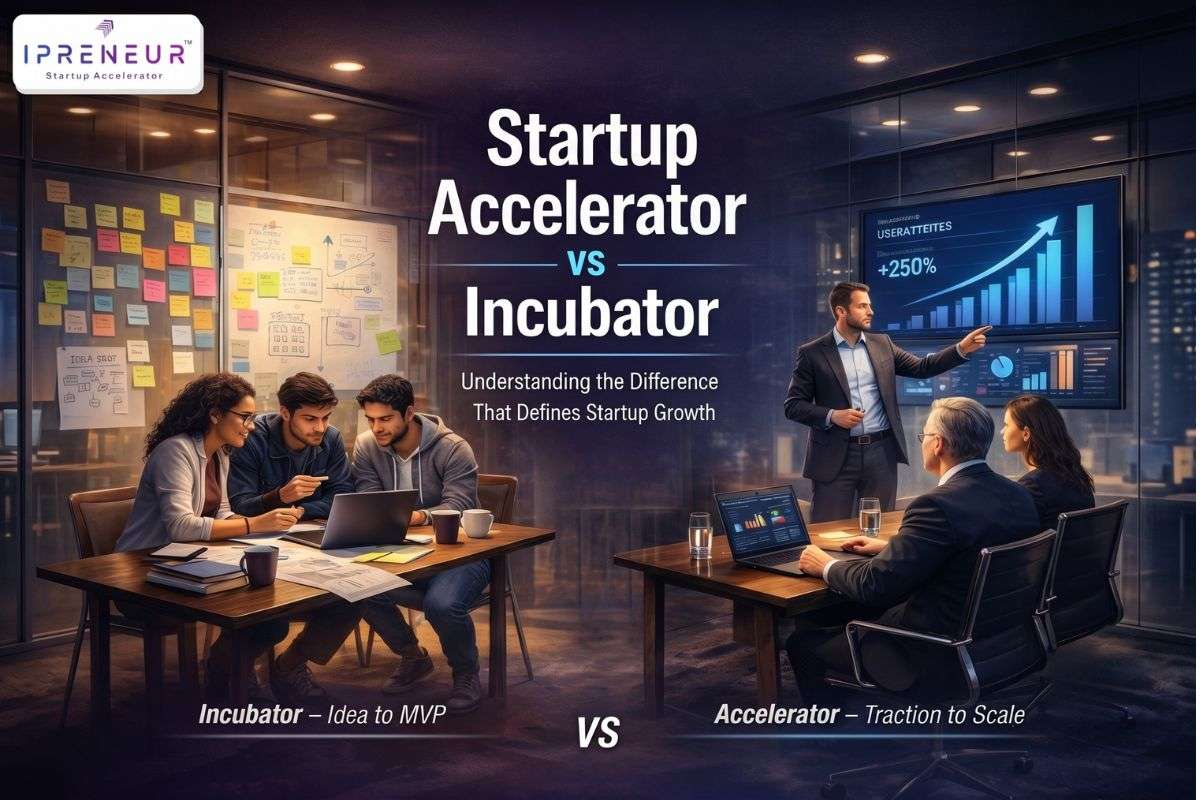
An incubator typically works with very early-stage startups — sometimes even at the idea stage. The focus is on nurturing concepts, validating business models, refining prototypes, and helping founders move toward an MVP. Incubators often provide foundational support such as workspace, basic mentorship, networking access, and academic or institutional backing. The environment is exploratory. The objective is to help founders move from uncertainty to initial clarity.
An accelerator, on the other hand, is built for momentum. It works with startups that already have a validated product, early revenue, or demonstrated traction. The question is no longer “Does this idea work?” but “How do we scale this efficiently and sustainably?” Accelerators are structured, time-bound, and execution-driven. They focus on refining go-to-market strategy, improving operational systems, strengthening governance, and preparing startups for serious capital engagement. The environment is performance-oriented. The objective is growth compression.
The confusion arises because both models offer mentorship and ecosystem access. However, mentorship alone does not define acceleration. The difference lies in structured execution and measurable outcomes.
In an incubator setting, founders are encouraged to experiment and iterate. In an accelerator, founders are expected to optimize, scale, and institutionalize. Incubation builds foundations. Acceleration builds engines. Within this context, Ipreneur positions itself clearly within the accelerator framework. Ipreneur is not designed for idea-stage ventures seeking exploratory validation. It is structured for revenue-generating startups that are ready to move from traction to scalable systems. The focus is on disciplined growth, operational clarity, and investor readiness.
Ipreneur’s COHORT model reflects the core philosophy of acceleration. Startups are selected based on defined readiness criteria, ensuring that participants are capable of benefiting from high-level strategic engagement. The program is time-bound and milestone-driven, emphasizing execution over theory. Rather than offering generalized advice, Ipreneur works as a Growth Acceleration Partner — guiding startups through structured diagnostics, growth mapping, go-to-market refinement, financial strengthening, and compliance alignment.
This clarity of positioning matters. Founders who are still validating their idea may benefit from incubation support. But founders who already have customers, revenue streams, and market traction require a different kind of intervention. They need frameworks that reduce inefficiencies, strengthen governance, optimize pricing strategies, and enhance investor confidence.
In India’s increasingly competitive landscape, scaling without structure can create internal strain. Teams expand without defined roles. Revenue grows without predictable systems. Investor conversations begin before financial discipline is in place. An accelerator bridges this gap by introducing accountability, performance tracking, and strategic oversight at the right growth inflection point. The real difference between an incubator and an accelerator lies in growth maturity and program intensity. Incubators prepare startups to enter the market. Accelerators prepare startups to dominate and scale within it.
For founders navigating the ecosystem, the decision should align with where their venture truly stands. If the goal is validation, incubation may be appropriate. If the goal is structured, measurable scale, an accelerator model like Ipreneur’s provides the architecture required for sustainable expansion. In a market where timing and precision define competitive advantage, clarity is power. And understanding the distinction between incubation and acceleration may be one of the most important strategic decisions a founder makes.
Disclaimer:
This article is for informational and thought-leadership purposes only. Views expressed are interpretative and based on publicly available information as of the date of publication. References to policies, budgets, or Infopace initiatives are illustrative and do not constitute legal, financial, or investment advice. Readers are encouraged to consult official sources and professional advisors where appropriate.