

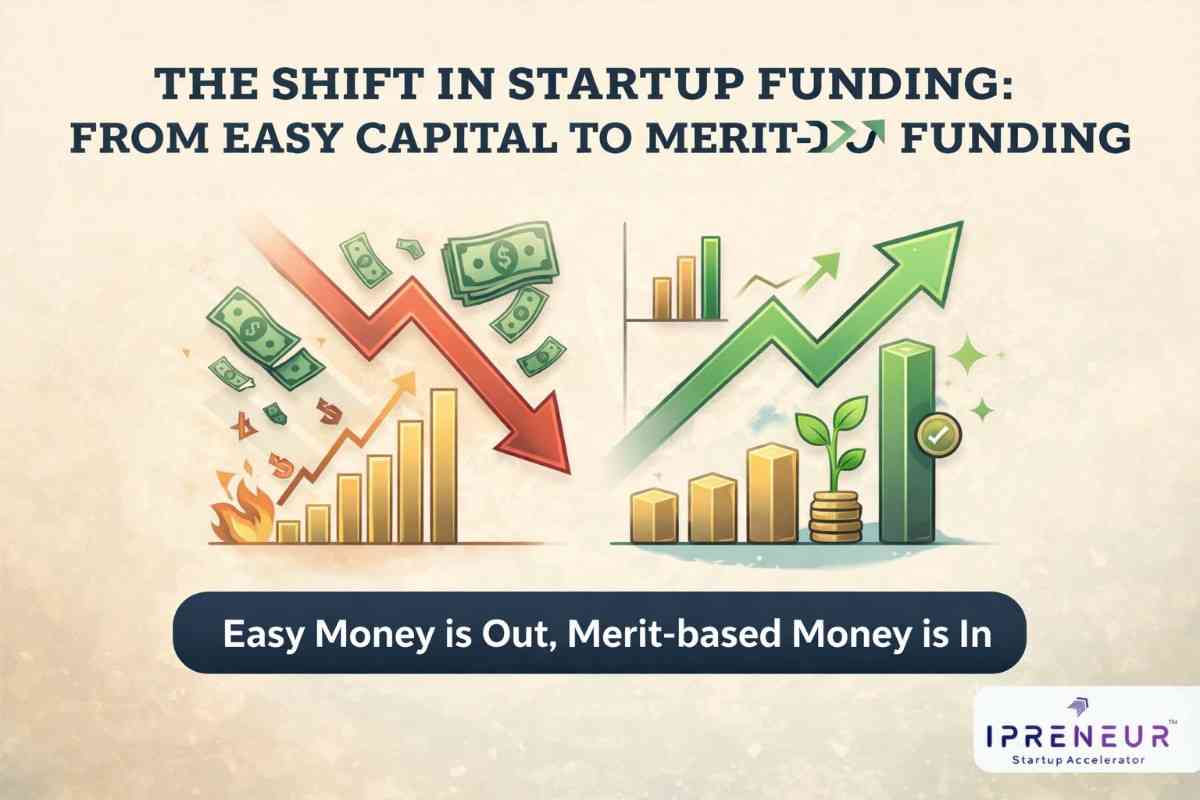
The narrative around startup funding has shifted dramatically. After a period defined by abundant capital and aggressive valuations, the ecosystem is now entering a more disciplined phase. Contrary to popular belief, funding has not disappeared—capital is still available and actively being deployed. However, what has changed is how that capital is allocated. Investors are no longer backing ideas on promise alone; they are prioritizing clarity, traction, and sustainable business models. In this new environment, the era of easy money is over.
Over the past year, global and Indian startup ecosystems have witnessed a recalibration. While investment volumes remain significant, funding decisions are becoming more structured and selective. Investors are taking a closer look at fundamentals—revenue consistency, unit economics, customer retention, and operational discipline. The focus has shifted from “how fast can you grow?” to “how sustainably can you scale?” This change reflects a maturing market where long-term value creation is taking precedence over short-term momentum.
For founders, this shift introduces both a challenge and an opportunity. The challenge lies in meeting higher expectations. Startups can no longer rely on strong storytelling or market size alone to secure funding. Investors are asking deeper questions: Is there real demand for the product? Are customers willing to pay? Can the business grow without excessive capital burn? Founders must now demonstrate clear revenue pathways, strong execution capability, and a deep understanding of their market.
At the same time, this environment creates an opportunity for serious builders. Startups that focus on fundamentals—building strong products, achieving product-market fit, and creating repeatable revenue models—are more likely to stand out. With less noise in the ecosystem, high-quality startups gain greater visibility and investor confidence. The funding landscape is not shrinking; it is becoming more merit-driven.
However, preparing for this new funding reality requires more than intent. Many founders struggle to align their business with investor expectations. They may have traction but lack structured financial planning. They may have a strong product but unclear go-to-market strategies. They may generate revenue but fail to communicate scalability effectively. This gap between potential and preparedness often becomes a barrier to raising capital.
This is where structured acceleration frameworks play a crucial role. Within the ecosystem of Ipreneur the focus is on assisting startups build fundraising readiness through execution discipline. Ipreneur’s COHORT-based model works with revenue-generating startups to strengthen the core pillars that investors evaluate—business model clarity, market positioning, operational systems, and financial strategy.
Through this structured approach, founders are guided to refine their narratives with data-backed insights, align their growth strategies with realistic projections, and build systems that demonstrate scalability. The cohort environment also enables peer learning, allowing founders to benchmark their progress and understand what it takes to succeed in competitive funding scenarios. More importantly, it in stills accountability—ensuring that strategic plans are translated into measurable outcomes.
In today’s funding landscape, preparation is as important as innovation. Investors are not just investing in ideas; they are investing in execution capability and strategic clarity. Startups that approach fundraising with structured thinking and disciplined operations are better positioned to build trust and secure capital.
The shift away from easy money does not signal a slowdown in entrepreneurship—it signals its evolution. The ecosystem is moving toward a phase where quality outweighs quantity, and where sustainable businesses attract long-term support. Founders who embrace this change will not only raise capital more effectively but also build stronger, more resilient companies.
In this new era, funding is still very much alive. But it belongs to those who can prove—not just promise—their ability to create value. And with the right guidance and structured acceleration , startups can transform this more selective environment into a powerful advantage for long-term growth.